The first devlog was about introducing Posterity, now it’s time to dig into what you actually do when you play it!
Foreword: game design and historical plausibility
When designing the core game loop of Posterity many months ago, I had in mind a battle against food scarcity, a game about summing up lots of micro-optimizations to slowly increase food collection efficiency which would then make the population grow. After all, this is the main growth engine in civ-like games: food is what dictates how fast and how high your population can grow.
Reading about the Paleolithic, this turned out to be a wrong depiction of how prehistoric hunter-gatherers actually lived. They rarely spent their whole days collecting food: when things got hard, they just migrated.
I considered shrugging this away for the sake of gameplay. But the more I thought about it, the more I felt the specific constraints of the time would make good gameplay mechanics.
A difficult aspect in designing a game with multiple, complex systems interacting with each other is to make sure they interact well, without unforeseen combos derailing the game (population or research explosion for example). Relying on what happened historically (or at least, what we think happened) helps making them consistent by construction: game design becomes a question of understanding historical constraints and turning them into good game mechanics.
Population growth is a good illustration. If food wasn’t the main limiting factor, what was?
Two main things:
- First, mobility: a band that keeps moving can’t raise many children at once (a mother can’t carry two toddlers across open country), so in Posterity, population growth depends on how long you manage to stay in one place
- Second, cohesion: beyond a few dozen people, social friction made bands harder to hold together, until they eventually split (which is easy when there’s enough land for everyone)
Both are key elements of the gameplay loop, the topic of today’s devlog.
Days of our prehistoric lives
In Posterity, a turn represents a few days’ worth of activities. Maybe four, maybe seven, the exact count doesn’t matter.
You start the game with a (thin) band of ten people, of which maybe seven can work (excluding children and elderly).
They are gathered around a single place that can barely be called a “camp”: don’t picture huts around a campfire, rather a temporary, unmarked place where they regroup regularly to sleep and bring back food for the young.
The camp is a bit like a Civilization city, with notable differences: you can have only one, it can easily be relocated on the map, and it doesn’t include buildings (at least early on).
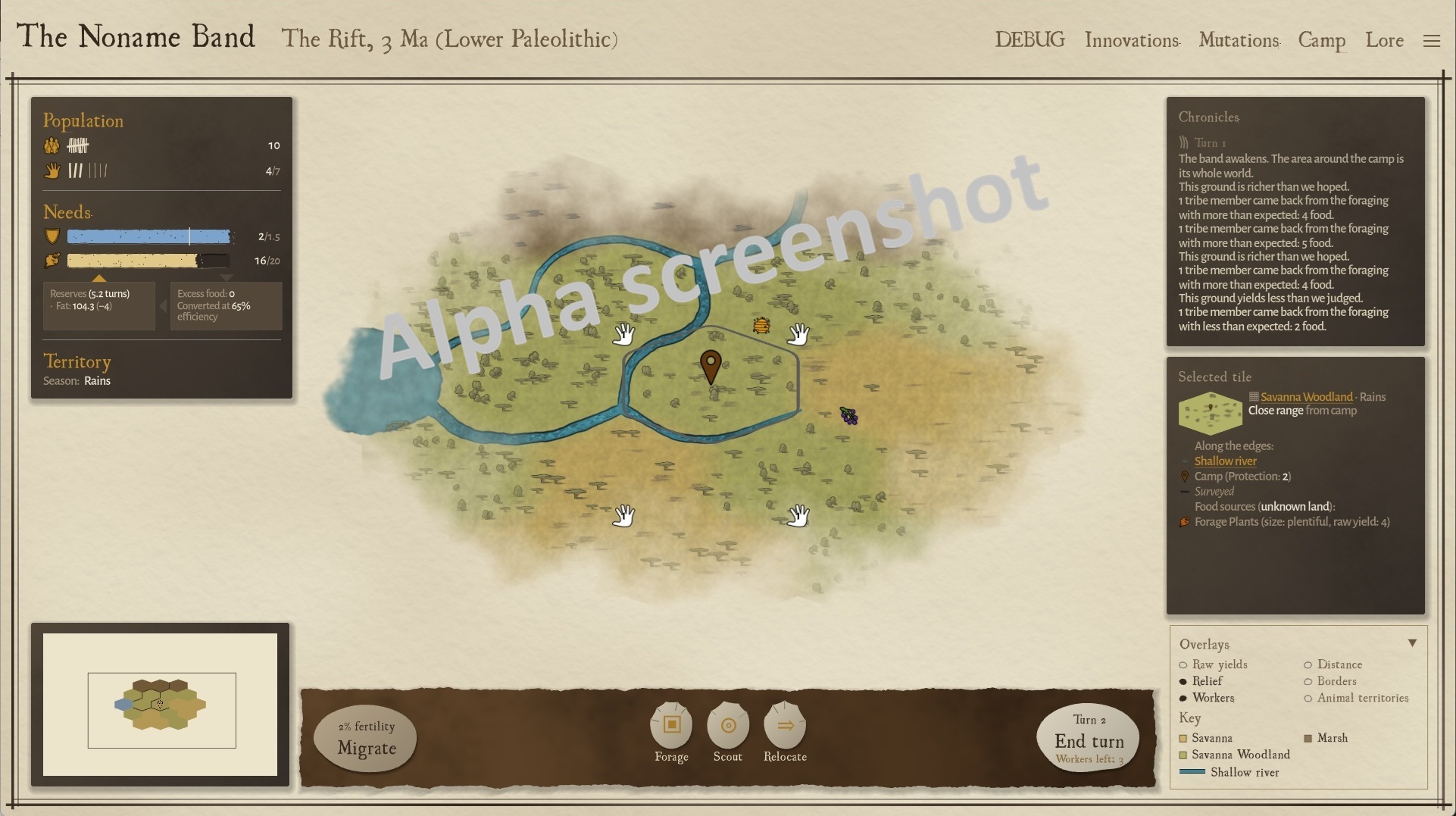
There are also no units in this game: you select an action type (a “verb”) such as collecting food or scouting, then click the tiles in the area around the camp to assign workers there (the farther, the less efficient to represent time spent walking there).
You won’t move a lone scout unit over thousands of kilometers, telegraphing its findings back to the camp: you can only scout a certain area around the camp, close enough for a scout to be back within a few days (i.e. a game turn).
Finally, once every worker is assigned, you click “End turn”, the actions are resolved, and you see what you got out of them.
In the beginning there were the verbs
There are twelve verbs (action types) in the game, grouped across four categories: Discovery, Sustenance, Crafting and Social (3 verbs each).
I won’t go through each of them in this devlog (or even reveal them yet, but you may try to guess!): each one is the tip of a deeper system that I will introduce in future devlogs.
I’ll still share a few words about the three verbs available at the very beginning of the game, Forage, Scout and Relocate, which together constitute the basis for the gameplay loop in its simplest form:
- Forage lets you collect food to sustain the band
- Scout lets you reveal new tiles and find more food sources
- Relocate lets you move camp closer to new food sources
(important note: relocating is not the same as migrating. Relocating is about moving camp on the map. Migrating is about leaving this map and moving to an entirely new one)

You’ll start with just these three, partly because it’s historically grounded, but more importantly because I don’t want people to get overwhelmed at the very beginning of the game (the first map will act as a tutorial). See it as the equivalent of early-game Civilization, where all you can do is move units, build a few things and found new cities.
Of course, this will get more complex over the course of the game, with more possibilities and new verbs becoming progressively available through innovations (technologies), something I’ll also cover in a future devlog.
Members and hands
The leftmost panel in the UI shows the important numbers you’ll want to keep an eye on.
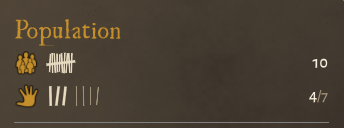
First, your population (the people symbol): how many people you have. Second, your workforce (the hand symbol): how many of them can work.
The second is obviously always lower than the first:
- Children and elderly need food, but don’t work. For now they represent a static 30% of the total tribe (this might change later)
- Some adult band members may become sick or wounded, when performing risky actions or if starvation hits. Again, they will eat, but can’t work, until they get better (or pass away…)
- Available workforce will be further reduced if the camp is far from a source of water. Water management is abstracted: there’s no drinking or water collection action, but if people need to spend time walking to a water source, they won’t be able to spend as much on other tasks
- Finally, as mentioned in the foreword, if the population grows too much, friction between members and inefficient collaboration will also decrease the workforce (until you find ways to increase your band’s cohesion)
You shouldn’t expect population and workforce to grow enormously during the game: maybe 50 or 100 by the end, but not thousands. This is a conscious gameplay decision (and a historically grounded one :) ): workforce assignment should remain a meaningful action, not a micromanagement feast.
The food conundrum
The second section of the panel, below the population and workforce, provides you with information about band maintenance.
I’ll leave aside the first bar for now and talk about the second one (with the turnip-like icon), the most important one in the game: the satiation bar.
It tells you how much food your band will need this turn, and how much is planned to be collected.
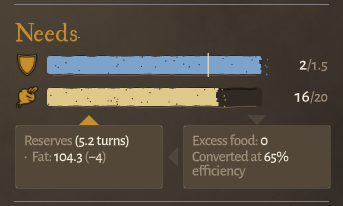
Each member of the band (working or not) requires 2 units of food per turn. As you assign people to food collection during the turn, the bar fills with the expected return.
Of course the goal is to fill the whole bar every turn to avoid starvation. But there’s more to it:
- Surplus goes into reserves: Eat more than you need, and you’ll convert the excess to metabolic reserves, i.e. fat. At the beginning of the game that’s the only form of storage you have; later in the game you’ll discover new ones
- Insufficient food collection draws from reserves: That’s what reserves are for: if for any reason you can’t fill the satiation bar on a turn, reserves will make up for it
- If reserves are insufficient, people starve: Depending on how much food is missing, one or more people fall sick, which means fewer workers next turn. This may turn into a spiral; while the game has no game over, it has consequences, so avoid starvation at all costs!
Of course, there’s a catch: food isn’t converted into reserves at 100% efficiency. The conversion rate tops at around 65% and is decreased based on how much excess food is eaten at once that turn and how many reserves the band already has.
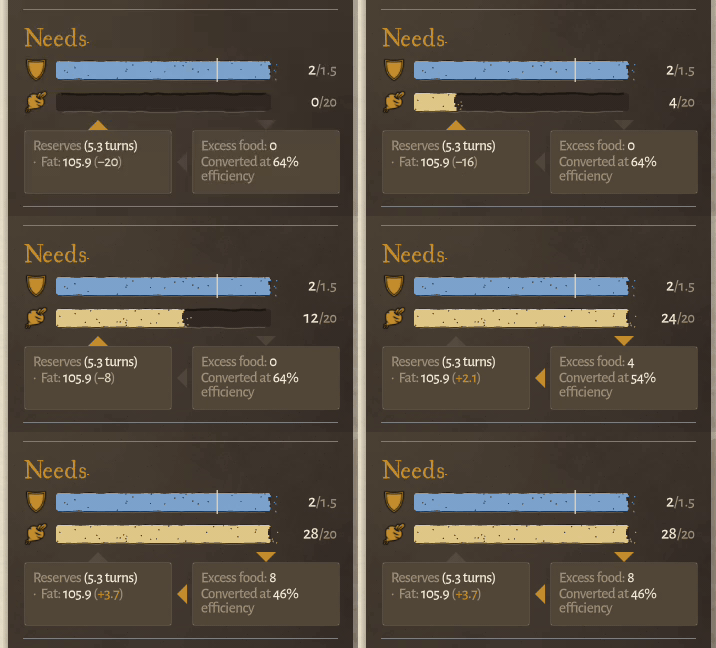
This is one of the game’s strategic decisions: Do you collect just enough food each turn to extend your stay as long as possible (and raise fertility)? Or do you build reserves, to be covered in case of a bad turn, but wasting food in the process?
If the first one sounds too easy, that’s because I haven’t mentioned that food collection isn’t always perfectly predictable… More on that in the next devlog.
Spare hands
Now for the interesting part. Coming back to what I mentioned in the foreword, prehistoric hunter-gatherers didn’t have to spend all their time collecting food. This was a thesis defended in particular by Marshall Sahlins’s Stone Age Economics. While the exact number of working hours iis still debated and shouldn’t be over-generalised, it’s broadly accepted that Paleolithic foragers weren’t constantly on the brink of starvation and that they had time for other activities.
In game terms, this means you won’t need to assign your whole workforce on food collection: the exact figure needs to be finetuned, but I expect that around 50% to 70% of the workforce should usually be enough to feed the tribe.
So the real question of each turn isn’t whether you’ll be able to feed the band. It’s what to do with the excess workforce.
This is where the decisions start:
- Do you send additional workers to collect more food than needed and build metabolic reserves?
- Do you scout the area for new foraging grounds to move to, anticipating that the area around the camp will sooner or later be depleted?
- Do you move the camp regularly to stay as close as possible to food sources and increase foraging efficiency?
And as the game progresses and your population grows, you’ll unlock many more ways to use your spare hands beyond direct or indirect food collection.
That said, the comfort of excess workforce will never last (at least in the Paleolithic). As the tiles around the camp get depleted, feeding the band will require a growing share of your workforce; relocating may temporarily alleviate this, but sooner or later you’ll want to leave the map entirely: that’s when you migrate.
Next time
As you may have guessed from the above, Forage is a very important verb, the one you’ll likely assign the most workforce to across the whole game.
Credit where credit is due, the next devlog will be dedicated to this verb, or more accurately, to the underlying system it is built on: foraging pools, yields, variance, uncertainty and depletion, and why foraging isn’t just a simple deterministic optimization problem.
In other news, I’ve just opened a few places to share these devlogs:
- Reddit: r/posteritygame
- Bluesky: @posteritygame.com
- CanardPC forum (French only): Forum thread
They can act as the comment section of these posts, so feel free to hop in to discuss this devlog or the game in general.
Until next time!
Cheshire